- Hospitals
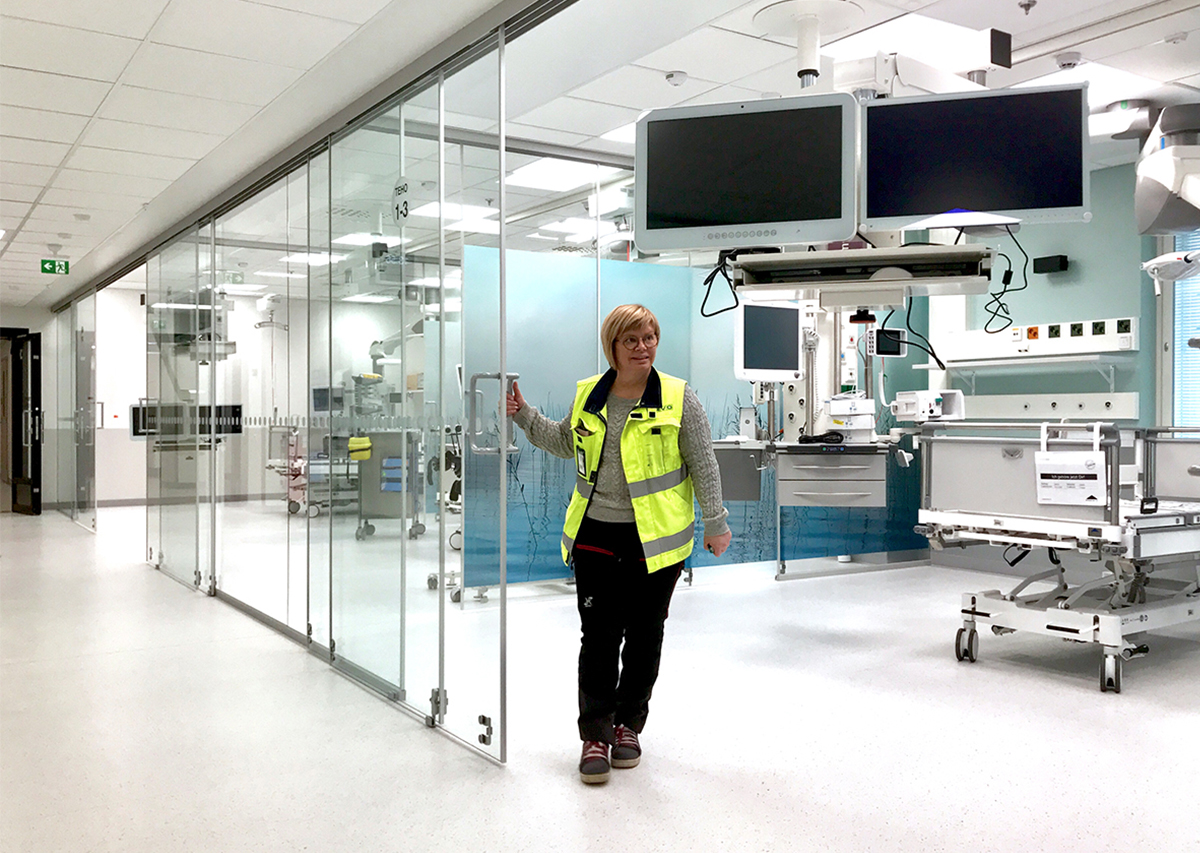
Glass partitioning solutions were tested on stretchers to make them user-friendly in the new extension of the North Karelia Central Hospital.
The space allocation solutions chosen for the new building of the North Karelia Central Hospital, the J2 extension, were intended to be as user-oriented as possible during the design phase. In several solutions, the weight of the products would have required the installation of rails or grooves in the floor, but this was not desired. In everyday use, the various obstacles and thresholds in the floor create uncomfortable situations for the hospital's customers. Patients' beds should not shake unnecessarily when they are moved from one place to another. Hospital instruments are also transported a lot inside the hospital and are not vibration tolerant. It was therefore decided to replace the grooved partitioning solutions in the original plans.
Glass partitioning solutions, without separate rail installation
- I set out to find glass partitioning solutions that do not require a separate rail installation in the floor. I went to the FP Products website, where I then found these almost frameless products, mainly aimed at offices. I contacted the FP Products Janne Tuokkola and inquired about the suitability of the products for hospital use. From there, things started to roll along nicely, comments the site engineer of the Siun sote J2 extension. Ani Parkkinen From Rakennustoimisto K. Tervo Oy.
”Now that I can see the implementation on site, I can say that the solutions found are better than we could have imagined.”
Ani Parkkinen Rakennustoimisto K. Tervo Oy
Paired impact-tested glass walls
In areas such as the joint emergency room control area and the intensive care and intensive care monitoring area, one of the guiding factors in the design was to ensure maximum visibility to patient areas. The design phase resulted in partly fixed and partly sliding glass wall and door solutions.
- Now that I can see the implementation on the ground, I can say that the solutions found are better than we could have imagined. The implementation supports the user's objective and will certainly have a positive impact on the smoothness and safety of care work," says the architect responsible for the architectural design of the project. Rami Kolehmainen Raami Architects Ltd.
In the J2 extension, the use of glass was desired because they did not want too fixed wall solutions, and curtains as space dividers did not seem to be the right choice either. However, glass partitioning solutions also raised doubts, particularly with regard to their durability. Under no circumstances was patient safety to be compromised.
- Together with the installers, we did test shots on the glass walls. We also carried out impact tests on stretchers. The tests clearly gave us a greater sense of security with these solutions, because that's how durable they are. In addition, the glass used in the products is safety glass, which, when broken, sticks to the laminating film," says the project's design coordinator Marko Turunen About Siun Sote's facility services.


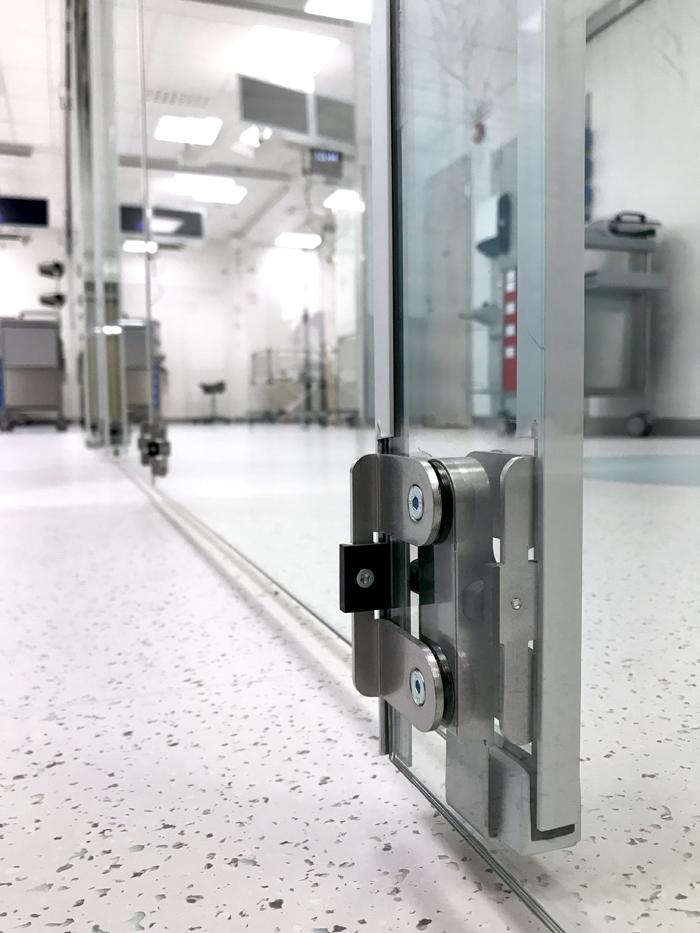
FP products' glass partitioning solutions bring light and transparency to the hospital. They also give a clean impression. Glass was a desirable element in the hospital and is also a good hygienic solution.
- The surfaces are clinical and easy to wipe clean. Glass walls and sliding glass doors could have been replaced by solid walls and curtains. However, glass walls and sliding glass doors instead of curtains give patients more privacy and peace. There is certainly also a greater sense of security," Turunen continues.
User-centred compromises
In the Siun Sote J2 extension, the user perspective has been a guiding factor in the design solutions. In user meetings, different views have been planned and reconciled together and the best possible alternative for the hospital's users and customers has been sought. For example, the size of the doors could be influenced during the design phase. Small details make a big difference in practice.
- In the worst case, the space cannot be used to the extent it was designed to be used. For example, if the door is turned in the wrong direction, it could mean that an XL-size bed cannot fit in the space. Fixing such problems afterwards is a difficult process and always more expensive. Through user-centred design, we have tried to find such challenges early on. However, these solutions are ultimately accepted by the users, and it is with them in mind that we have come up with these products," Turunen concludes.
Interested?
Are you looking for flexible space allocation solutions for a space you are designing? Let's design together - we'll make a space for you and your vision, offering expert service and quality space allocation solutions.
Discover our glass wall solutions

FP sliding glass wall 0dB
FP sliding glass wall 0dB is the best choice for a glass partition wall when you want an easy-to-use partitioning solution that maintains a sense of space and light. The FP partition wall is not a sound-insulating partitioning product. If you are looking for a sound-absorbing glass wall solution, check out our FP glass folding wall , DEKO FG Silent glass wall or FP partition wall for Dorma Variflex.
- An easy-to-use partitioning solution that maintains a sense of space and light in the room
- Several door options
- Several locking options up to burglar-proof locking




DEKO FG Silent glass wall
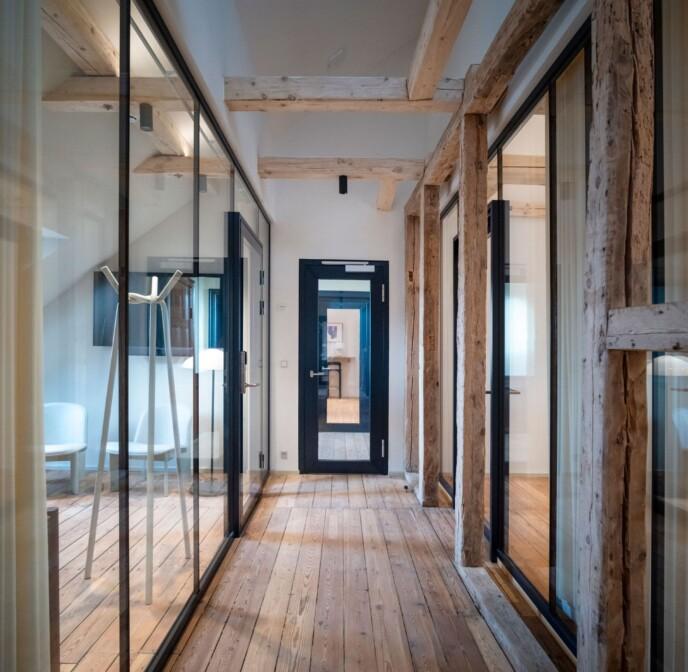
DEKO FG Silent is a floor-to-ceiling glass wall system that provides up to 50 dB of sound insulation with a 2K glass element only 43 mm thick. The glass panels are mounted on a slim aluminium frame and the vertical seams can be finished with either a stylish silicone strip or aluminium profile to complete the modern look.
- Single-layer glass with aluminium frame
- Up to 50 dB sound insulation
- Same design as the FP glass partition wall
DEKO FG2 glass wall
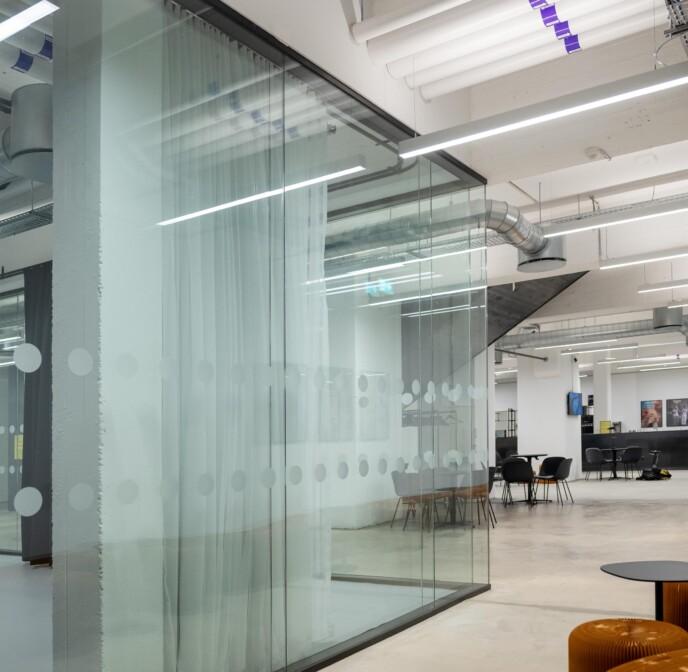
DEKO FG2 is an all-glass wall that provides maximum light output with a minimalist design. The FG2 has two glass panels with an air space between them for excellent sound insulation.
- Two layers of glass
- Up to 53 dB sound insulation
- Several colour options for profiles
- Easy to combine with other products

FP Sliding Glass Door
FP-Product's new sound-insulating glass sliding door meets even the most demanding space planning and acoustic requirements in an unprecedented way.
This innovation combines stylish design with top-class sound insulation. Thanks to its sliding mechanism, it can also be used in smaller spaces, making it possible to create multifunctional and practical environments where both privacy and data protection are considered, while maintaining a bright and comfortable atmosphere.
The minimalist and refined appearance of the glass sliding door is emphasized by a frame that covers the edges of the glass, allowing the glass surface to shine seamlessly from edge to edge.
- Top-level sound insulation – up to Rw 42 dB
- Modern and transparent design
- Easy to maintain and keep clean
- Excellent solution for small spaces
- Also available in any desired RAL color.

DEKO Tré - glass wall system
DEKO Tré is a sealed and fire-rated all-glass wall system that also provides excellent sound insulation. The system makes it easy to design a coherent look for the whole space. This stylish glass wall system is available in three different types of wood.
- Oval wooden profile
- Available as sound-laminated, fire-retardant or insulating glass
- Fire resistance and sound insulation
- Oak, ash, pine
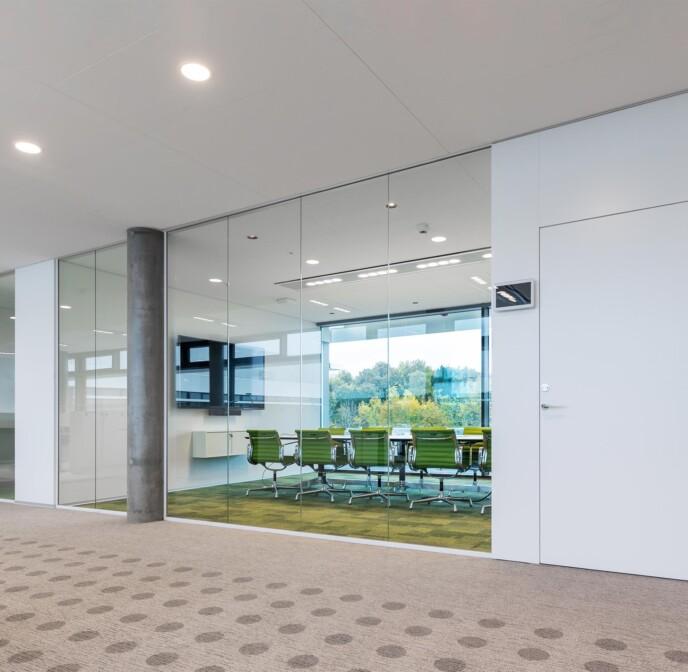
DEKO FG glass wall
The fully glazed divider adds exceptional lightness to the space, maximising natural light and creating a spacious, open feel. DEKO FG consists of a single floor-to-ceiling glass panel. The system is attached to the surrounding structure by narrow aluminium profiles.
- Made almost entirely of glass
- Rw 34-42 dB sound insulation
- Many different glass options
- Possibility of better sound insulation or fire protection features